


The Complete Guide to Property Maintenance in Florida: Protect Your Investment Year-Round
January 19, 2026
Groundwater & Hydrostatic Pressure Management in Fort Lauderdale: Protecting Foundations and Coastal Structures
February 27, 2026
Chloride Ion Penetration: The Electrochemical Threat
Chloride-induced corrosion represents the most significant threat to concrete structures in Fort Lauderdale's coastal environment. The electrochemical process begins when chloride ions (Cl⁻) from salt-laden air and seawater penetrate the concrete matrix, disrupting the protective alkaline passivity layer surrounding steel reinforcement bars.
In normal conditions, concrete maintains a pH level between 12.5 and 13.5, creating a passive oxide film on embedded steel that prevents corrosion. However, when chloride concentrations reach the critical threshold of 0.6 to 1.2 lbs per cubic yard (or 0.4% by weight of cement), this protective layer breaks down, initiating active corrosion.
The Corrosion Mechanism:
- Anodic Reaction: Iron oxidizes (Fe → Fe²⁺ + 2e⁻), releasing electrons and forming ferrous ions.
- Cathodic Reaction: Oxygen and water consume electrons (O₂ + 2H₂O + 4e⁻ → 4OH⁻)
- Rust Formation: Ferrous ions combine with hydroxyl ions to form rust (Fe(OH)₂), which expands up to 600% in volume
- Concrete Spalling: Expansion creates tensile stresses exceeding concrete's capacity (typically 400-500 psi), causing cracking and delamination
Fort Lauderdale's proximity to the Atlantic Ocean creates an especially aggressive environment. Atmospheric chloride deposition rates in coastal areas within 1,000 feet of the shoreline can reach 50-150 mg/m²/day, compared to just 5-10 mg/m²/day in inland locations. This means structures in neighborhoods like Galt Ocean Mile, Lauderdale-by-the-Sea, and Las Olas Isles experience chloride ingress rates 10-15 times higher than inland properties.
The diffusion coefficient of chloride ions in concrete typically ranges from 1×10⁻¹² to 1×10⁻¹¹ m²/s, but this rate accelerates significantly in Fort Lauderdale due to:
- High relative humidity (averaging 75-85% year-round) that keeps concrete pores saturated
- Temperature fluctuations between 65°F and 95°F that create thermal cycling and microcracking
- Wind-driven rain during hurricane season (June-November) that forces chloride-laden water into concrete surfaces
- Tidal action in waterfront properties that creates wet-dry cycles, accelerating ion transport
Research conducted by the Florida Department of Transportation (FDOT) indicates that concrete structures in South Florida coastal zones can experience chloride penetration depths of 1-2 inches within just 5-10 years of exposure, compared to 20-30 years in non-coastal environments. This accelerated timeline necessitates proactive inspection and maintenance protocols.
In normal conditions, concrete maintains a pH level between 12.5 and 13.5, creating a passive oxide film on embedded steel that prevents corrosion. However, when chloride concentrations reach the critical threshold of 0.6 to 1.2 lbs per cubic yard (or 0.4% by weight of cement), this protective layer breaks down, initiating active corrosion.
Hydrostatic Pressure & Groundwater Infiltration
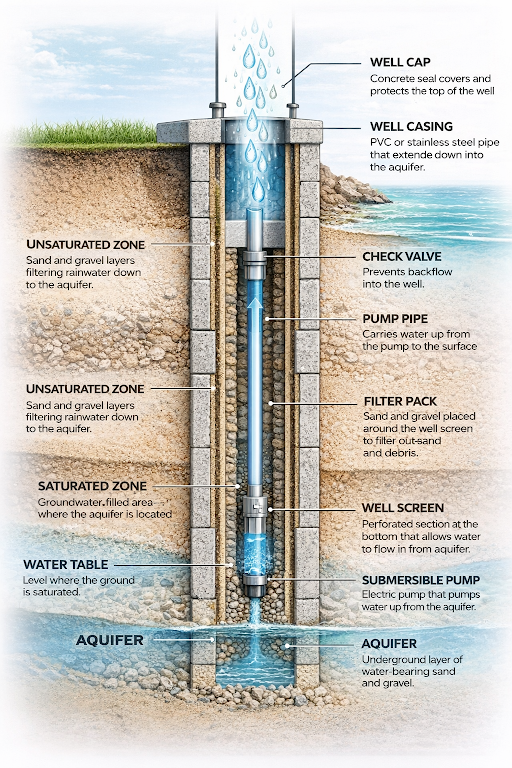
Fort Lauderdale's unique hydrogeological setting creates significant challenges for below-grade concrete structures. The city sits atop the Biscayne Aquifer, a highly permeable limestone formation that maintains groundwater levels typically 2-6 feet below ground surface, with seasonal variations of 1-3 feet during wet season (May-October).
Hydrostatic pressure, the force exerted by standing water against subterranean surfaces, increases at a rate of 0.433 psi per foot of water depth. For a basement or foundation extending 8 feet below the water table, this translates to approximately 3.5 psi of constant pressure against foundation walls and floor slabs. While this may seem modest, it represents a continuous force of over 500 pounds per square foot.
Critical Neighborhoods Affected:
- Las Olas Boulevard: Water table elevation 2-4 feet below surface; high infiltration risk in historic buildings
- Victoria Park: Limestone bedrock at 6-12 feet depth; solution channels create preferential flow paths
- Rio Vista: Proximity to New River creates elevated groundwater; frequent flooding during king tides
- Coral Ridge: Porous coral rock foundation; rapid water infiltration during heavy rainfall
The rising water table phenomenon in Fort Lauderdale is well-documented. According to the Southeast Florida Regional Climate Change Compact, sea-level rise projections for Broward County indicate:
- 2030: 3-5 inches of sea-level rise above 2000 baseline
- 2050: 10-17 inches of sea-level rise
- 2070: 21-40 inches (1.75-3.3 feet) of sea-level rise
- 2100: 40-69 inches (3.3-5.75 feet) of sea-level rise
This rising water table directly impacts the effective stress on foundation systems and increases hydrostatic loading on basement walls, parking garage substructures, and below-grade utility vaults. The Biscayne Aquifer's high permeability (hydraulic conductivity of 10,000-100,000 feet/day) means that groundwater responds rapidly to tidal fluctuations and rainfall events.
Concrete degradation mechanisms associated with hydrostatic pressure include:
- Hydraulic fracturing: Water pressure exploits existing microcracks, propagating them through the concrete matrix
- Sulfate attack: Groundwater in South Florida often contains 200-500 ppm sulfates, which react with calcium aluminate hydrates to form expansive ettringite crystals
- Alkali-aggregate reaction (AAR): Moisture facilitates reaction between alkaline pore solution and reactive silica in aggregates, causing expansion and cracking
- Leaching: Continuous water flow dissolves calcium hydroxide from concrete, reducing pH and compromising structural integrity
The Florida Building Code (FBC) 2023 Section 1805 requires waterproofing for all foundation walls retaining earth and enclosing interior spaces below grade. However, many older structures in Fort Lauderdale (pre-2000 construction) lack adequate waterproofing systems, making them particularly vulnerable to hydrostatic pressure damage.
Carbonation Depth: The Silent pH Reducer
Carbonation is a chemical process where atmospheric carbon dioxide (CO₂) diffuses into concrete and reacts with calcium hydroxide (Ca(OH)₂) in the pore solution, forming calcium carbonate (CaCO₃) and water. This reaction progressively reduces the concrete's pH from its normal alkaline state (pH 12.5-13.5) to near-neutral levels (pH 8-9), eliminating the protective passivation layer on steel reinforcement.
The Carbonation Reaction:
CO₂ + Ca(OH)₂ → CaCO₃ + H₂O
(Carbon dioxide + Calcium hydroxide → Calcium carbonate + Water)
Fort Lauderdale's subtropical climate creates ideal conditions for accelerated carbonation. The city experiences:
- High relative humidity: 75-85% average, optimal for CO₂ diffusion (carbonation peaks at 50-70% RH)
- Elevated temperatures: Average annual temperature of 77°F accelerates chemical reaction rates
- Atmospheric CO₂ concentration: Currently ~420 ppm globally, but urban areas can experience 450-500 ppm
- Wet-dry cycling: Frequent rainfall followed by rapid evaporation creates optimal moisture conditions
The carbonation front advances into concrete at a rate proportional to the square root of time, following the relationship: x = k√t, where x is carbonation depth (mm), k is the carbonation coefficient (mm/year⁰·⁵), and t is time (years). In Fort Lauderdale's environment, typical carbonation coefficients range from 3-7 mm/year⁰·⁵ for normal-strength concrete (3,000-4,000 psi), compared to 2-4 mm/year⁰·⁵ in drier climates.
This means that after 25 years of exposure, carbonation depth in Fort Lauderdale structures can reach:
- Low-quality concrete (w/c ratio > 0.6): 35-50 mm (1.4-2.0 inches)
- Medium-quality concrete (w/c ratio 0.5-0.6): 20-35 mm (0.8-1.4 inches)
- High-quality concrete (w/c ratio < 0.5): 10-20 mm (0.4-0.8 inches)
Since typical concrete cover over reinforcement ranges from 1.5-2.5 inches (38-64 mm) per ACI 318-19 requirements, carbonation can reach steel reinforcement within 15-30 years in many Fort Lauderdale structures, particularly those with inadequate cover depth or high-permeability concrete.
Factors accelerating carbonation in Fort Lauderdale include:
- Cracking: Microcracks from thermal stress or structural loading provide direct pathways for CO₂ ingress
- Low cement content: Older structures may have used lean mixes with insufficient calcium hydroxide reserves
- Porous concrete: High water-cement ratios create interconnected pore networks facilitating gas diffusion
- Inadequate curing: Insufficient hydration reduces concrete density and increases permeability
- Surface contamination: Salt deposits and biological growth can alter surface pH and moisture retention
The synergistic effect of carbonation and chloride ingress is particularly damaging. Carbonation reduces the chloride binding capacity of concrete, allowing more free chlorides to reach reinforcement. Additionally, the pH reduction from carbonation lowers the chloride threshold required to initiate corrosion from 0.6% to as low as 0.2% by weight of cement.
Detection methods for carbonation include phenolphthalein indicator testing (turns pink above pH 9.5, remains colorless below), which provides immediate visual assessment of carbonation depth during core sampling and inspection procedures.
Critical Fact:
In Fort Lauderdale, chloride threshold levels for corrosion initiation often exceed 1.2 lbs per cubic yard due to proximity to the Atlantic Ocean and Intracoastal Waterway, accelerating reinforcement deterioration by 300-400% compared to inland structures.