


Milestone Repairs: Protecting Florida Properties Through Concrete Restoration, Waterproofing, and Protective Coatings
May 7, 2026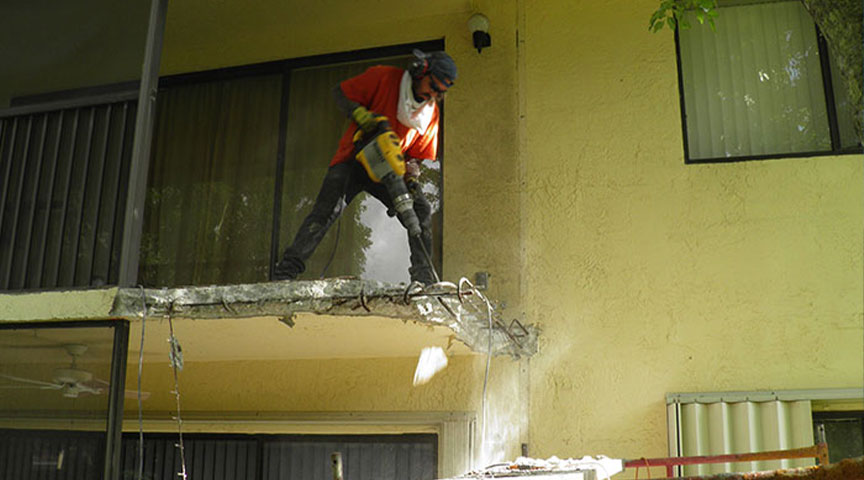
Why Florida Changed the Rules
On June 24, 2021, Champlain Towers South in Surfside, Florida collapsed. Ninety-eight people died. The investigation that followed exposed what engineers had warned about for years: deferred maintenance, underfunded reserves, and structural deterioration that condominium associations had repeatedly voted to ignore rather than pay to correct.
Florida's response was Senate Bill 4-D, signed into law in May 2022 and codified primarily in Florida Statute 553.899. The law was later refined by SB 154 in 2023, HB 1021 in 2024, and HB 913 in 2025. Together, these statutes form the most aggressive condominium safety framework in the United States.
For property owners, condominium boards, and association managers, the message from Tallahassee is unambiguous: inspect, fund, and repair or face the consequences.
This article explains what the law requires, what happens when you fail to comply, and why every month of delay multiplies your exposure.
What the Law Actually Requires
Florida SB-4D applies to condominium and cooperative buildings three or more stories tall. There are three core obligations.
1. Milestone Structural Inspections
A licensed Florida engineer or architect must perform a structural inspection when the building reaches a defined age:
- 30 years of age is the statewide default, based on the date the certificate of occupancy was issued
- 25 years of age if the local enforcement agency determines that local conditions — such as proximity to salt water — justify a shorter timeline
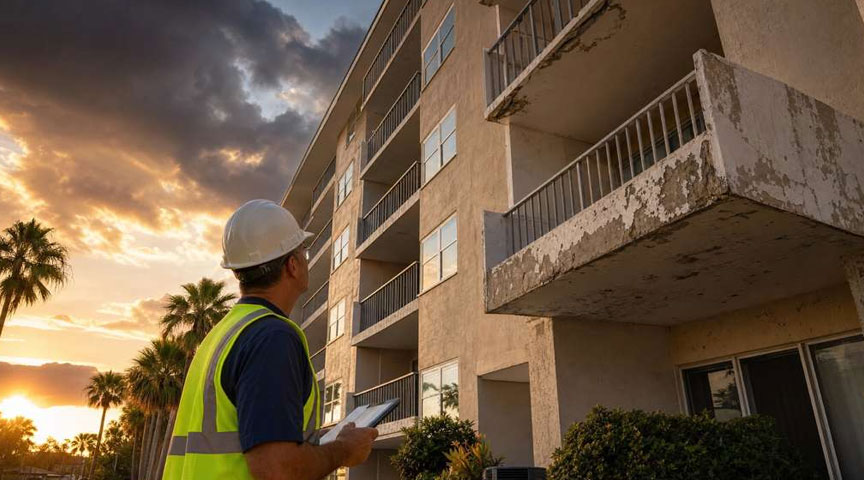
The inspection has two phases. Phase 1 is a visual examination of major structural components: load-bearing walls, foundations, floor and ceiling systems, columns and beams, and the building envelope. The inspector looks for concrete spalling, post-tension cable issues, excessive cracking, and moisture intrusion. If Phase 1 finds substantial structural deterioration, Phase 2 is mandatory, and Phase 2 includes materials testing, core sampling, and direct probing of structural elements.
After the initial inspection, re-inspection is required every 10 years.
2. Structural Integrity Reserve Studies (SIRS)
Every condominium and cooperative three stories or higher must commission a Structural Integrity Reserve Study. The SIRS identifies eight mandatory structural components, estimates their remaining useful life, and projects the cost of future repair or replacement. The study must be updated every 10 years.
3. Mandatory Reserve Funding
This is where the law has its sharpest teeth. As of January 1, 2026, Florida banned reserve waivers for eight mandatory SIRS components: roof, load-bearing walls and primary structural members, fire protection, plumbing, electrical, waterproofing, windows and exterior doors, and any other item with a deferred maintenance or replacement cost exceeding $10,000.
For decades, Florida condo boards routinely voted to waive or reduce reserve funding to keep monthly assessments low. That option is now closed for structural components. Boards must fund the reserves identified in the SIRS — and they must use those funds only for the items the study identified.
The Critical Deadlines
The law sets firm deadlines based on the building's age:
- Buildings with a certificate of occupancy issued on or before July 1, 1992 (30+ years old as of 2022): initial milestone inspection was due December 31, 2024
- Buildings that turned 30 years old between July 1, 2022 and December 31, 2024: initial inspection deadline was December 31, 2025
- Buildings reaching the age threshold in 2026 or later: must complete the inspection by December 31 of the year they hit the threshold
For SIRS, the SIRS may be completed simultaneously with the milestone inspection, but in no event later than December 31, 2026.
If your building is past any of these dates and the inspection has not been completed, you are non-compliant, and the consequences are no longer theoretical.
What Happens When You Don't Comply
This is the section every board member and property manager must read carefully. Florida built real teeth into this law, and they are being used.
State-Level Fines
The Florida Department of Business and Professional Regulation (DBPR), through the Division of Florida Condominiums, Timeshares, and Mobile Homes, can issue civil penalties. SB-4D authorizes fines of up to $5,000 per violation from the DBPR, and the Division has enforcement authority over compliance with milestone inspection and SIRS requirements.
Local Enforcement Fines
Local building departments have independent enforcement authority. Local building departments can issue violations and impose fines, which vary by jurisdiction but can reach $10,000 or more per month. These accumulate continuously until the building is brought into compliance. A building that delays for a year can accumulate six figures in fines from local enforcement alone.
Loss of Certificate of Occupancy and Vacate Orders
If an association fails to begin repairs, the local enforcement agency must review whether the building is unsafe for human occupancy. That can lead to a vacate order forcing residents out. Once a vacate order is issued, the building cannot be legally occupied until the structural deficiencies are corrected and the certificate of occupancy is reinstated.
For owner-occupied units, this means displacement. For investment owners, it means total loss of rental income while the building sits empty.
Personal Liability for Board Members
This is the consequence most board members do not understand until it is too late. Board members who willfully fail to arrange inspections may face personal liability for breach of fiduciary duty under Section 718.111.
Personal liability means a board member's own assets not just the association's can be reached in litigation by unit owners, lenders, or injured third parties. SB-4D also provides for potential criminal charges for board members who fail to comply in defined circumstances.
The board's traditional shield of "we voted to waive it" is gone. The vote itself can now be the liability.
Loss of Insurance Coverage
Insurers may deny coverage or refuse renewal for non-compliant buildings. A building without master property insurance is, for practical purposes, unsellable, unfinanceable, and unsafe. Most mortgages require continuous master coverage; without it, lenders can call loans due.
Loss of Conventional Financing
Perhaps the most damaging consequence for unit owners individually: The building may be added to Fannie Mae's unavailable list, blocking conventional mortgage financing for all unit sales. When this happens, sales collapse to cash buyers only, and cash buyers expect deep discounts. Unit values can fall 20% to 40% almost overnight.
Mandatory Disclosure to Buyers
Florida Statute 718.504 requires sellers to disclose specific structural and financial documents when selling a condominium unit. The Florida Realtors/Florida Bar Condo Rider, updated in December 2024, reinforces these requirements. Sellers must provide milestone inspection reports, Structural Integrity Reserve Studies (SIRS), and documentation of any special assessments related to building safety, whether pending or already completed.
The absence of these documents is itself a red flag that kills sales and triggers price reductions.
The Real Cost: A Compounding Math Problem
Boards often delay because the inspection itself looks expensive. The actual numbers vary widely by building size and condition. Phase 1 (visual) inspections cost $8,000 to $150,000+ depending on building size. Small buildings (10-30 units) typically pay $8,000 to $25,000. Large high-rises pay $50,000 to $150,000+. Phase 2 (detailed testing), if triggered, adds $40,000 to $250,000+.
Now compare that to the cost of non-compliance:
- DBPR fines: up to $5,000 per violation
- Local fines: up to $10,000+ per month, accumulating
- Lost rental income during a vacate order: thousands per unit per month
- Insurance non-renewal: building uninsurable
- Fannie Mae unavailability: 20–40% drop in unit values across the entire building
- Personal liability exposure for every board member
- Emergency special assessments levied on owners under crisis conditions
The inspection is the cheapest line item on this list. Every other consequence is a multiple of it.
Why You Need a Contractor Ready Before the Report Lands
The milestone inspection itself is only the beginning. If the engineer's report finds substantial structural deterioration, and many do - the association has limited time to begin corrective work. Local enforcement agencies can require repair plans within statutory windows, and continued non-compliance triggers the cascade of penalties described above.
Boards that wait until the report is in their hand to start looking for a licensed restoration contractor often face:
- Inflated emergency pricing from contractors who know the building has no leverage
- Long lead times for engineering, permits, and material procurement
- Pressure from insurers, lenders, and unit owners that compresses decision-making
- Board members second-guessing decisions made under duress
The buildings that handle milestone repairs successfully are the ones whose boards engaged a qualified restoration contractor early before the report, or immediately after it, and built a phased repair plan rather than a panic plan.
What a Qualified Restoration Partner Provides
Milestone repair work is specialized. A qualified contractor brings:
- Licensed general contracting credentials with verified Florida restoration experience
- Coordination with the engineer of record to translate inspection findings into a defensible scope of work
- Concrete restoration, waterproofing, and protective coatings delivered as one integrated program
- Phased execution in occupied buildings, minimizing disruption to residents
- Documentation that satisfies local building officials, insurers, and the association's records obligations under the law
- Manufacturer-certified system warranties that protect the association's investment for years after the project closes
We bring all of this. More importantly, we bring a single point of accountability concrete, waterproofing, and coatings delivered by one contractor, on one schedule, under one warranty.